How To Download A Squarespace Site To HTML And Self Host
If you love building on Squarespace but feel the hosting is too expensive for your needs—or you simply want full control over your files—converting your website to static HTML and self-hosting can be a smart move. In this step-by-step guide, you’ll learn how to download a Squarespace site to HTML, optimize it for performance and SEO, and deploy it to the host of your choice. We’ll use ExFlow, a reliable Squarespace Exporter and Squarespace Downloader that makes exporting, syncing, and hosting straightforward.
Why self-host your Squarespace site?
- Cost savings: If Squarespace feels too expensive for your project, self-hosting is a cost-effective Squarespace alternative.
- Performance: Static files (HTML/CSS/JS) are fast to serve and easy to cache globally.
- Control: Keep your own backups, choose your CDN/host, add custom scripts or build workflows with Git.
- Portability: Move providers freely without being locked in.
Note: Always respect platform Terms of Service and ensure you own or have rights to export and host the content. If a site is password-protected, ExFlow can access it when the owner provides the password.
What you’ll need
- Your Squarespace site URL (live domain or built-in preview domain)
- A hosting destination (choose ExFlow Hosting, Amazon S3 + CDN, GitHub Pages, or any FTP-accessible server)
- Optional: Git, S3, or FTP credentials for automatic syncing
- Your custom domain registrar access (to point DNS)
Step 1 — Download your Squarespace site to HTML with ExFlow
ExFlow is a purpose-built Squarespace to HTML exporter that bundles your entire site into clean static assets. It captures pages, CSS, JS, and media files so you can download your Squarespace site and redeploy it anywhere.
- Go to https://exflow.site
- Paste your site URL
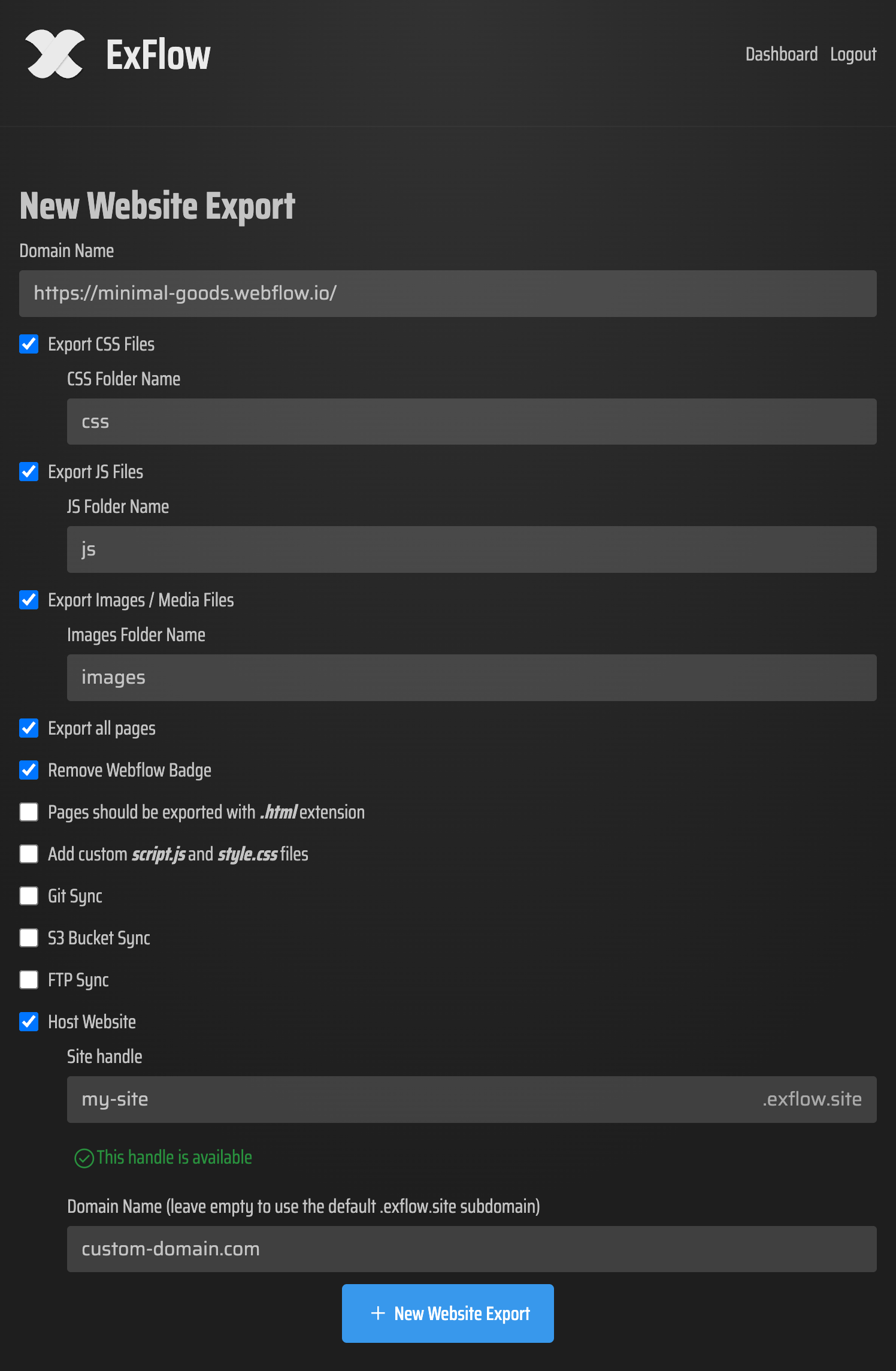
- Configure export options:
- Export CSS files
- Export JS files
- Export Images / Media files
- Export All Pages (recommended for complete coverage)
- Add custom script.js and style.css files
- Pages exported with .html extension
- Optional: Sync Git, Sync S3, Sync FTP
- Optional: Hosting on ExFlow with unlimited bandwidth + custom domain linking
- Start the export and wait for processing
- Download the ZIP or let ExFlow sync directly to your target host

Quick look at the ExFlow export screen
Step 2 — Choose how you’ll self-host your static site
Option A: Host on ExFlow (fastest)
- During export, select Hosting
- Once deployed, link your custom domain in ExFlow
- Enjoy unlimited bandwidth and a simple dashboard to view hosting status
- Ideal for non-technical teams who want a one-click Squarespace alternative for hosting
Option B: Amazon S3 (+ optional CloudFront)
- In ExFlow, enable S3 Sync and provide your bucket name and credentials
- In AWS, enable static website hosting on the bucket (index.html as default; 404.html as error, if needed)
- Set bucket policy and public access rules according to your security/CDN needs
- Optional: Put CloudFront in front for global performance and HTTPS; point your domain’s CNAME/ALIAS to CloudFront
Option C: GitHub Pages (or similar Git-based hosts)
- In ExFlow, enable Git Sync and connect your repository
- Push the exported files to the branch used by your host (e.g., main/docs for GitHub Pages)
- Configure Pages settings; set index.html as entry point
- Commit changes to redeploy
Option D: Any traditional web host via FTP
- In ExFlow, enable FTP Sync and provide host/username/password
- Specify your web root (e.g., /public_html or /var/www/site)
- ExFlow uploads your HTML, CSS, JS, and media in one shot
- Confirm your server is configured to serve index.html by default
Step 3 — Point your domain and enable HTTPS
- Update DNS at your registrar:
- A/AAAA records for server IP, or
- CNAME/ALIAS to your CDN or hosting endpoint
- Enable HTTPS:
- ExFlow Hosting: configure SSL from the dashboard
- S3/CloudFront: use ACM certificates
- GitHub Pages: enable Enforce HTTPS
- Traditional hosts: install Let’s Encrypt or provider-issued SSL
Step 4 — QA, performance wins, and SEO checks
- Crawl your site: Verify all pages exported and internal links are correct
- Relative vs absolute URLs: Prefer relative paths to keep environments portable
- Images: Compress and lazy-load where appropriate; serve modern formats if available
- Caching: Set long cache headers for CSS/JS/images; cache-bust with file hashes when updating
- 404 and redirects: Provide a custom 404.html; add 301 redirects if URLs changed
- Metadata and sitemaps: Confirm titles, meta descriptions, Open Graph tags, and a static sitemap.xml
- Robots.txt: Ensure it’s correct for your environment
- Analytics and forms: Swap in static-friendly services (see below)
What won’t work after converting to static HTML (and how to replace it)
- Native e‑commerce cart/checkout: Use a buy-button provider or headless checkout embedded via JS
- Dynamic forms: Replace with services like Netlify Forms, Basin, or Formspree
- Site search: Add a client-side search (e.g., Algolia or Lunr) and pre-index content
- Member areas/scheduling: Use third-party widgets or dedicated SaaS embeds
Why use ExFlow for Squarespace to HTML?
- True Squarespace Downloader: Export all pages, styles, scripts, and media into ready-to-serve static files
- One workflow, many destinations: Download or sync to Git, S3, FTP, or host directly on ExFlow
- Add your own scripts and styles: Inject custom script.js and style.css during export
- Unlimited bandwidth hosting: Keep traffic costs predictable on ExFlow Hosting
- Password-protected sites: Supported when the site owner provides the password
If you’re comparing your options because Squarespace is too expensive for your current needs, ExFlow offers a practical Squarespace alternative: build on a great visual editor, then export and self-host.
Important notes about credentials and security
- For Git/S3/FTP syncing, you’ll provide credentials during setup; handle them securely and only share what’s necessary
- Rotate keys periodically and remove unused tokens
- Restrict access scopes where possible (e.g., bucket-only permissions)
FAQ
Can I re-import my static site back into Squarespace? Not as a site you can edit visually. Static export is best for hosting and preservation.
Will my SEO carry over? Yes—your titles, meta tags, content, and URLs will carry over if you keep the same structure and redirects. Add sitemap.xml and keep canonical tags current.
Does this include every piece of dynamic functionality? No. Static HTML is ideal for content-driven sites. Replace forms, search, and carts with lightweight services as needed.
Is this allowed? You must own the content or have rights to export it. Always follow platform terms and applicable laws.
Call to action
Ready to Download your Squarespace Site and self-host it with confidence? Start your export with ExFlow today: https://exflow.site — the fastest Squarespace Exporter for turning your site into portable, performance-focused HTML.
Optional: Explore hosting right on ExFlow to skip server setup and link your custom domain in minutes.
Bonus visual: ExFlow in action

Comments
Post a Comment