How To Sync Notion Pages With Webflow CMS Automatically
If you write in Notion but publish on Webflow, the fastest way to eliminate copy‑paste, broken formatting, and manual updates is to set up automatic syncing. In this guide, you’ll learn exactly how to sync Notion pages with your Webflow CMS—on autopilot—using SyncFlow.
SyncFlow lets you map your Notion database fields to Webflow CMS fields, auto-publish new or updated content, and even preserve code highlights and math expressions. The result: a content pipeline that’s fast, reliable, and scalable.
What you’ll need
- A Notion workspace with permission to share a database
- A Webflow project with a CMS Collection ready
- A SyncFlow account: https://syncflow.ybouane.com/
Why automate Notion → Webflow CMS
- Eliminate manual copy-paste and formatting issues
- Keep posts in sync automatically when you edit in Notion
- Centralize content ops: authors draft in Notion; Webflow reflects changes
- Speed up publishing with auto-publish and field mapping
Key features you’ll use
- Auto-Sync: Every new or updated Notion page is synced automatically
- Auto-Publish: Instantly publish synced changes on your Webflow site
- Versatile field mapping: Text, images, checkboxes, dates, URLs, and more
- Code highlighting + TeX support: Ideal for technical or academic posts
- Page linking: Notion page mentions become internal links on your site
- Fully customizable styling: Import inline styles or map classes for full design control

How to sync Notion with Webflow (step-by-step) 1) Visit SyncFlow and get started Go to https://syncflow.ybouane.com/ and click Get Started. Create an account or log in.
2) Grant access to your Webflow sites Approve the requested permissions so SyncFlow can read/write to your Webflow CMS collections.
3) Launch the SyncFlow app in Webflow Open your Webflow project’s Designer and start the SyncFlow app from the Apps panel.
4) Connect your Notion workspace In SyncFlow, click Connect Notion and select the page or folder that contains your database. Grant access.
5) Create a new sync task Click Sync a new database in SyncFlow. This links one Notion database to one Webflow CMS Collection.
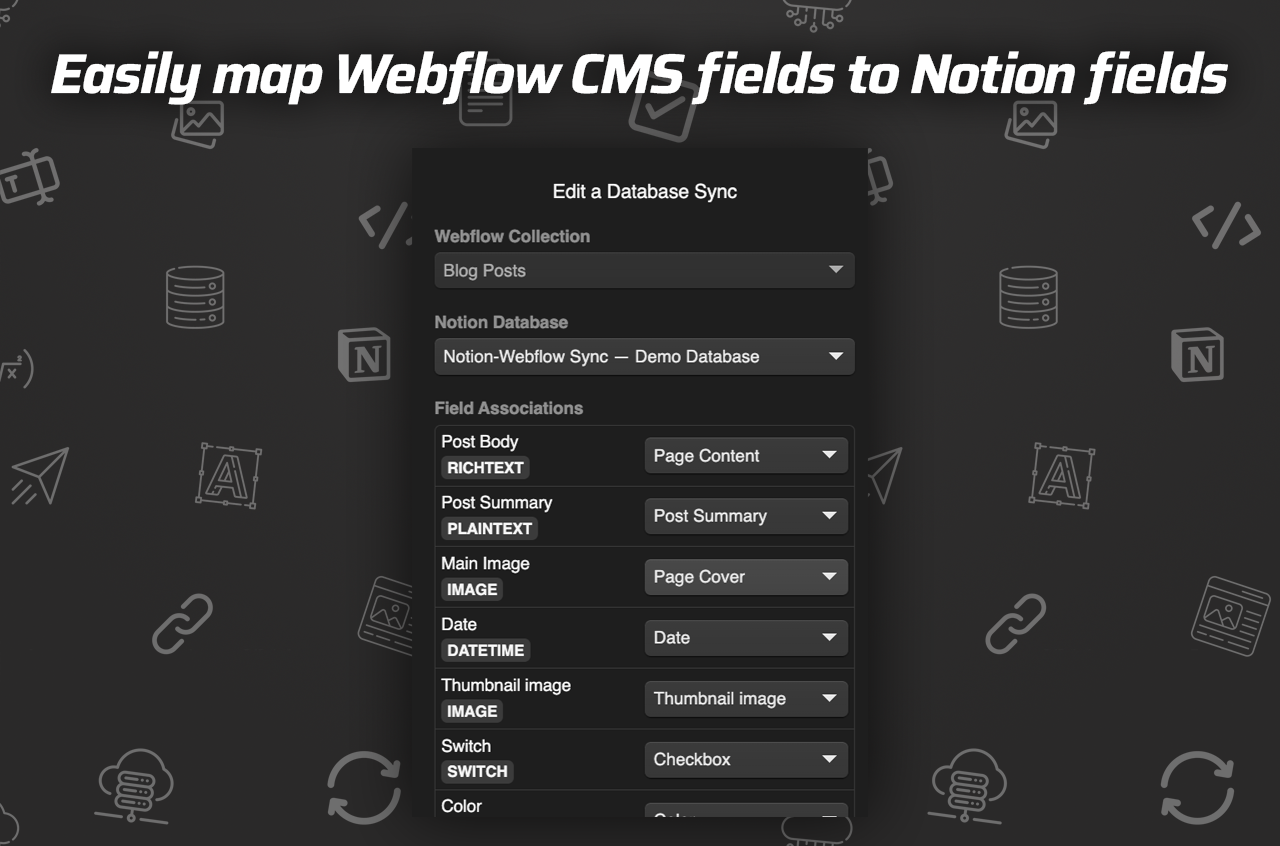
6) Choose your Webflow Collection Select the CMS Collection (e.g., Blog Posts) you want to populate from Notion.
7) Select or create your Notion database
- Pick an existing database, or
- Create a new one—SyncFlow can auto-create the required fields for you.
8) Map fields precisely Match Notion properties to Webflow fields (e.g., Title → Name, Cover Image → Main Image, Summary → Plain Text, Tags → Multi-Reference). This is where you define the one‑to‑one relationship between your content source and destination.
9) Choose styling strategy
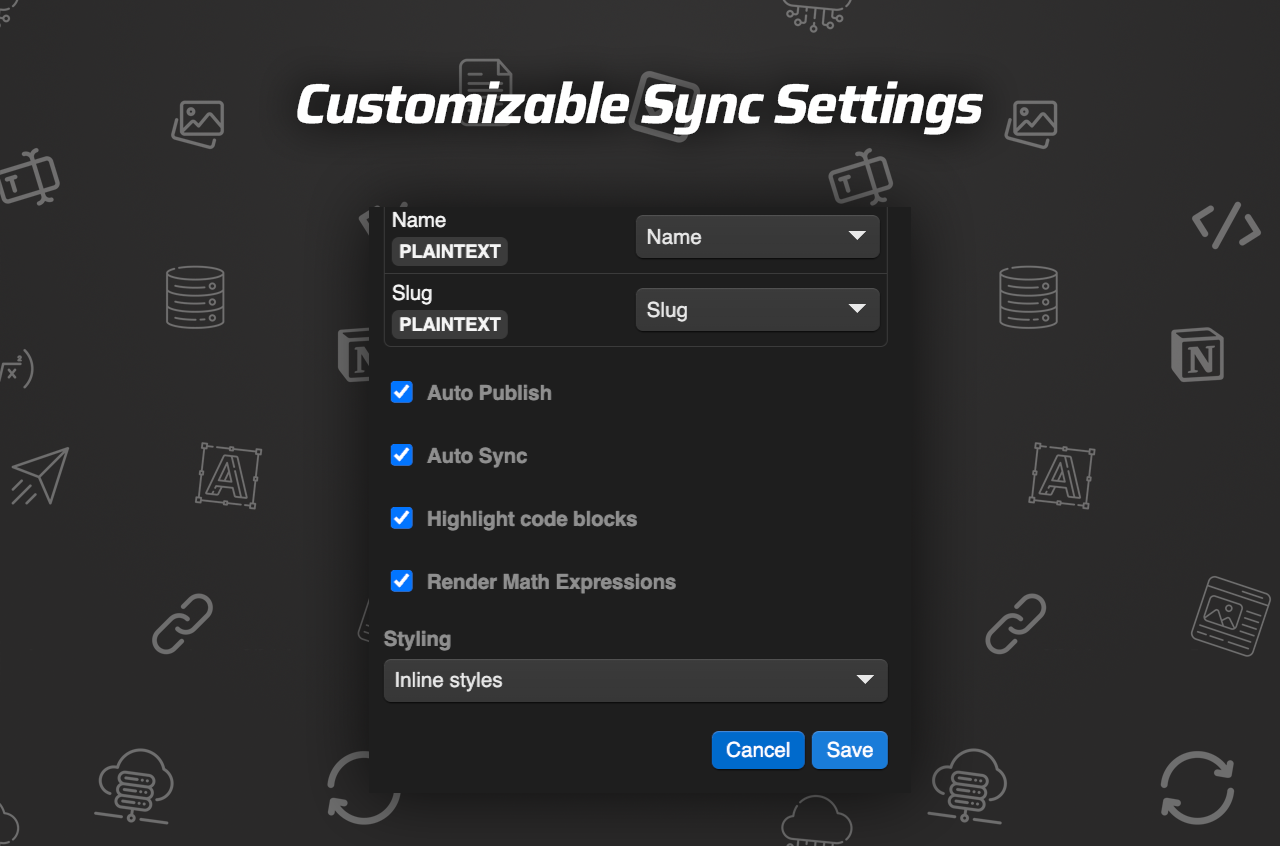
- Inline Styles: Import Notion’s formatting as-is for speed.
- Use Classes: Map block types to CSS classes in Webflow for full design control.
10) Configure automation settings Toggle Auto-Sync to push changes when pages are created or edited in Notion. Enable Auto-Publish to publish the CMS item immediately after each sync.
11) Enable advanced content features Turn on code block highlighting and TeX rendering if your posts include code samples or mathematical expressions.
12) Save and verify Save your settings, add a test entry in Notion, and confirm the item appears in your Webflow CMS Collection. Open the published page to verify formatting, images, and links.
Optional: Run a full resync If you have an existing database, use Full Resync to align your entire Webflow Collection with the Notion database in one go.
Pro tips for a clean, SEO-friendly pipeline
- Design your Notion database first: Add properties for Title, Slug, Summary/Description, Cover Image, Tags/Categories, Author, Published Date, and Canonical URL.
- Control slugs: Create a Notion text property for Slug so your URLs are stable and SEO-friendly.
- Optimize images: Include Alt Text as a Notion property mapped to the main image’s alt field.
- Keep summaries tight: Map a 150–160 character Summary to your CMS meta description.
- Use classes for scale: If you manage brand typography in Webflow, choose Use Classes so your imported content inherits design tokens.
- Test one content type at a time: Perfect your blog Collection mapping before adding others (e.g., case studies, docs, changelog).
Troubleshooting checklist
- Permissions: Ensure SyncFlow has access to both your Notion database and your Webflow site.
- Field type mismatches: Confirm that text, image, and reference fields are mapped to compatible types in Webflow.
- Missing images: Verify the Notion image property is a file/image type, not just a URL in a text field.
- Reference fields: For categories/tags, create and populate the reference Collections in Webflow first, or let SyncFlow manage them via mapped fields.
- Update delays: Auto-sync runs quickly, but allow a short delay. Use manual sync if you need immediate updates during testing.
- Overwrites: When testing, keep Auto-Publish off until you’re confident your mappings are correct.
Watch the how-to videos
- Full tutorial: https://www.youtube.com/watch?v=_890vYoe3KQ
- Feature trailer: https://www.youtube.com/watch?v=HGjBCLL3anc
Who benefits most from automatic Notion → Webflow syncing?
- Content teams: Draft collaboratively in Notion; publish automatically to Webflow.
- Technical blogs: Maintain code formatting and math without extra plugins.
- Product & docs: Keep changelogs, release notes, and documentation perfectly in sync.
- Agencies: Standardize client content workflows and reduce publishing overhead.
Why choose SyncFlow for this workflow
- Speed to value: 3 simple steps—install, map fields, sync
- Reliability: Real-time Auto-Sync + Auto-Publish keeps your site current
- Flexibility: Inline or class-based styling to match any design system
- Depth: Code highlighting, TeX rendering, and page-to-page linking out of the box
- Pricing: Simple $8/month Standard plan with unlimited syncs, databases, and connected fields
Get started now
- Create your account: https://syncflow.ybouane.com/
- Map your first Notion database to your Webflow CMS
- Toggle Auto-Sync + Auto-Publish and watch updates go live automatically
Frequently asked questions Q: Can I preview before publishing? A: Yes. Leave Auto-Publish off while you test mappings. When you’re ready, enable it so approved updates go live instantly.
Q: Does it support multiple Webflow sites? A: Yes, you can install SyncFlow on multiple projects. The Standard plan is $8/month per site with unlimited syncs.
Q: What about internal links between pages? A: SyncFlow converts page mentions in Notion into links between corresponding CMS items in Webflow.
Q: Can I switch styling later? A: Absolutely. You can start with Inline Styles for speed and later switch to Use Classes for fine-grained control in Webflow.
Q: How do I migrate existing posts? A: Point SyncFlow to your existing Notion database, map fields, and run a full resync to populate your Webflow Collection.
Next steps
- Explore SyncFlow: https://syncflow.ybouane.com/
- Set up your first sync in minutes and reclaim hours every week by writing in Notion and publishing to Webflow automatically.
Ready to automate your content ops? Click Get Started on the SyncFlow homepage and go live today.

Comments
Post a Comment