How to Download a Squarespace Site to HTML for Self Hosting
If you love designing on Squarespace but find hosting too expensive or limiting, there’s a practical alternative: export your site to static HTML and self-host it. This approach can cut monthly costs, boost performance, and give you full control over your stack. In this guide, you’ll learn how to use a Squarespace Exporter to download your site and deploy it anywhere — all without rebuilding from scratch.
Why self-host a Squarespace site?
- Cost savings: If you’re thinking “Squarespace too expensive,” static hosting on a CDN, object storage, or a lightweight VPS can be a fraction of the price.
- Speed and reliability: Static HTML/CSS/JS served from edge locations is blazing fast.
- Flexibility: Integrate your own analytics, forms, and deployment workflows.
- Ownership: Keep a complete copy of your site’s HTML, assets, and structure.
What Squarespace doesn’t provide natively Squarespace doesn’t offer a full “Download Squarespace site to HTML” option. The built-in export is limited and focused on moving content to other platforms (e.g., XML) — not a drop-in static site. That’s where a third-party Squarespace Downloader helps.
Meet ExFlow: a Squarespace Exporter built for self-hosting ExFlow is a tool that captures your published site as static files — HTML, CSS, JS, and images — and packages everything so you can host it anywhere. It works with Squarespace (and also with Webflow), supports exporting all pages, and can optionally sync your export to object storage, FTP, or a version-control repository. It even offers built-in hosting with unlimited bandwidth and custom domain linking depending on your plan.
Key features for Squarespace to HTML with ExFlow:
- Export HTML pages with .html extensions
- Include CSS, JS, images, and other media
- Export all pages (including collection-driven pages as static output)
- Add custom script.js and style.css for post-export tweaks
- Optional sync: S3-style object storage, FTP, and version-control repositories
- Optional hosting on ExFlow servers (link your own domain)
- Works with password-protected sites when you provide the password

Step-by-step: Download a Squarespace site to HTML and self-host it 1) Prepare your site
- Clean up navigation, remove unused pages, and publish your latest changes.
- Replace any functionality that depends on server-side features with static-friendly alternatives (more on that below).
2) Open the Squarespace Downloader
- Go to ExFlow.site and choose Squarespace export.
- Enter your site URL. If your site is password-protected, provide the password so ExFlow can access it.
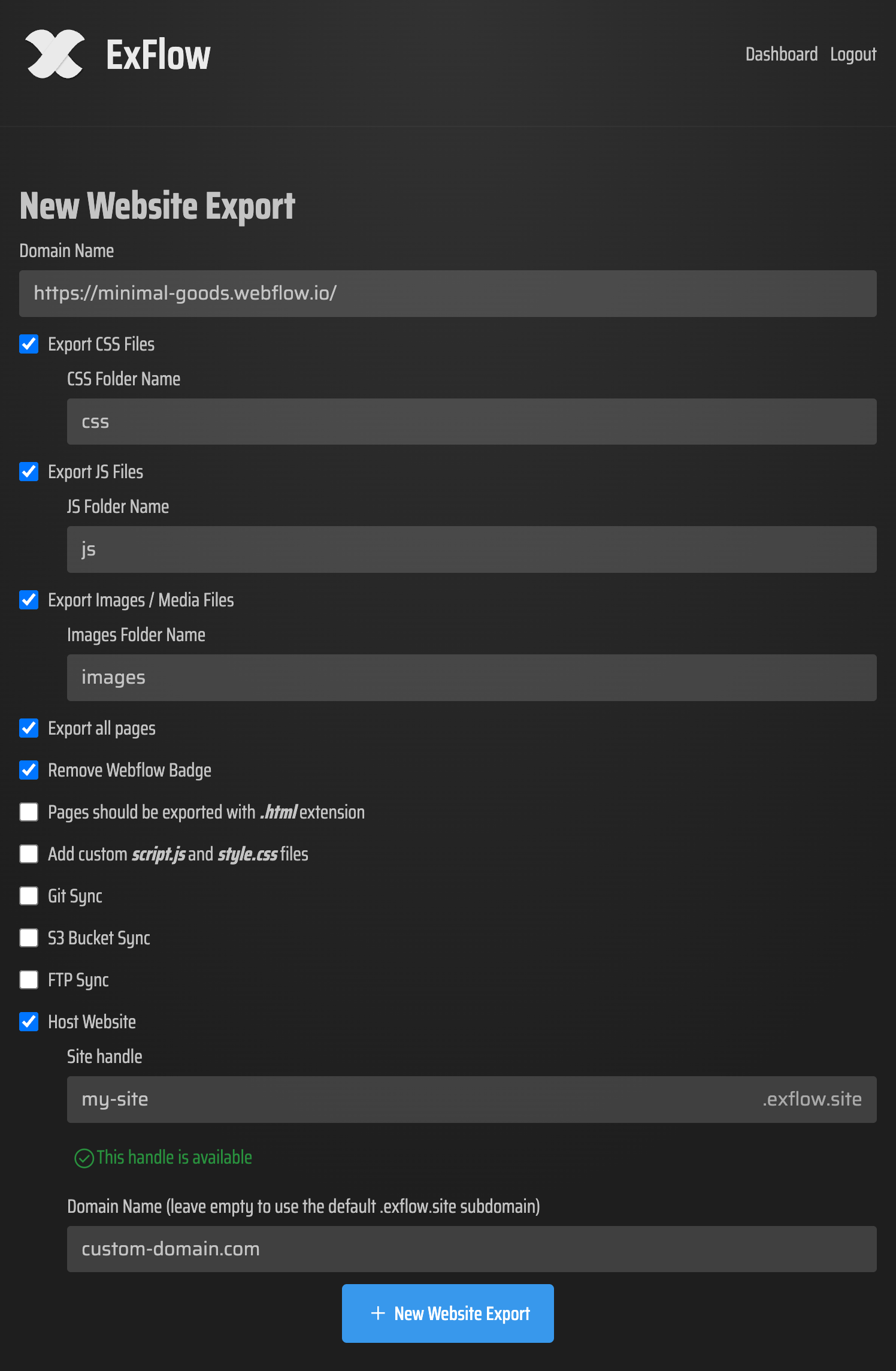
3) Configure export settings
- Export all pages to ensure complete coverage.
- Include CSS files, JS files, and media (images/video).
- Ensure pages export with the .html extension.
- Optionally add custom script.js and style.css to layer tweaks after export.
4) Start the export
- ExFlow crawls your published site, captures HTML, downloads assets, and resolves internal links so your static copy works on any host.
5) Download or sync your site
- Download a ZIP containing your HTML, CSS, JS, and images.
- Or automatically sync to your destination:
- Object storage (e.g., S3-style buckets)
- Version-control repository (for workflows like GitHub Pages/Netlify)
- FTP (traditional shared hosting) Note: To use sync, you’ll add credentials for your target. Only provide credentials to services you trust and rotate them periodically.
6) Test locally
- Unzip the export, open index.html in your browser, and click through pages.
- Verify navigation, images, fonts, and internal links.
7) Deploy and self-host You’ve got multiple options:
- Host on ExFlow: The simplest route — enable hosting during export and point your custom domain. Unlimited bandwidth means predictable performance spikes are covered.
- Object Storage (S3-style): Upload the files, enable static website mode, and use a CDN for global delivery.
- Version-Control Hosting: Push to a repository and deploy via GitHub Pages, Cloudflare Pages, or Netlify.
- FTP to a Server: Upload to your provider and serve as a static site.
What changes when moving from Squarespace to static HTML? Converting to static HTML is ideal for content-focused sites, portfolios, docs, and marketing pages. However, dynamic features that rely on Squarespace’s backend won’t carry over automatically. Here’s how to handle them:
- Forms: Replace Squarespace forms with a static-friendly form handler (e.g., serverless endpoints or third-party form services). Update your exported HTML form action to the new endpoint.
- Search: Use a client-side search library or a hosted site search service.
- Commerce: Static exports don’t preserve a transactional backend. Link to an external checkout, embed a headless cart, or keep commerce on Squarespace while exporting the brochure parts.
- Member areas: Not supported in a pure static workflow; consider a headless auth service if needed.
SEO and performance checklist for your static deployment
- Preserve URL structure: Keep paths consistent to avoid broken links.
- 301 redirects: Map any changed URLs to maintain rankings.
- Canonicals and meta tags: Confirm they’re present in your exported HTML.
- Sitemaps and robots.txt: Generate and upload a fresh sitemap.xml; confirm robots.txt is correct.
- Image optimization: Serve modern formats and enable CDN-level caching.
- Analytics: Add your preferred analytics snippet (e.g., privacy-friendly, lightweight).
Why ExFlow over other approaches?
- One-click Squarespace to HTML: No rebuilding, no guesswork.
- All-in-one workflow: Export, then download or sync to storage/FTP/repo.
- Optional hosting with unlimited bandwidth and custom domains.
- Scales with your needs: Choose a plan that matches your number of sites, exports per month, and export size limits.
Common questions
- Can I download any Squarespace site? Only export sites you own or have explicit permission to export.
- Will blog posts and collection pages export? They’ll export as static HTML at their public URLs. Dynamic editing features won’t carry over, but the rendered pages will.
- Can I keep my exact design? Yes — your HTML, CSS, and JS are captured as rendered, so the exported site should look the same.
- What about passwords? ExFlow can access password-protected sites when the owner supplies the password.
The fastest path to a self-hosted Squarespace alternative If you’re searching for “Squarespace Alternative,” “Squarespace to HTML,” or “Download Squarespace Site,” ExFlow is purpose-built for the job. In minutes, you can create a clean, portable static copy and host it on your terms.
Get started now
- Try the Squarespace Downloader at ExFlow.site
- Export your site, download the ZIP, or enable hosting with a custom domain
- Deploy confidently with speed, control, and lower costs
Ready to self-host your Squarespace site? Start your export today at ExFlow.site and take full control of your website’s performance, budget, and future.

Comments
Post a Comment