How To Download A Squarespace Site To HTML Safely And Quickly

When you need to Download a Squarespace Site to HTML—whether because Squarespace is too expensive for your use case, you want a Squarespace alternative for hosting, or you simply prefer full control—doing it safely and quickly is key. In this guide, you’ll learn a reliable Squarespace to HTML workflow, how to avoid common pitfalls, and how to self-host your Squarespace site without breaking layouts, animations, or media.
Pro tip: The simplest route is using a dedicated Squarespace Exporter like ExFlow, which is purpose-built to capture all pages, CSS, JS, and images, then package them into clean .html files (and even deploy for you). Start here: https://exflow.site
Why export your Squarespace site to HTML?
- Cost savings: Host static HTML anywhere—object storage (S3), Git-backed hosts, or traditional shared hosting. Great if Squarespace feels too expensive.
- Speed and stability: Static HTML is fast and resilient with minimal server overhead.
- Ownership and portability: Keep a portable backup and move providers freely.
- Flexibility: Inject custom scripts/styles, integrate with workflows, and use advanced CI/CD.
The fastest safe method (overview)
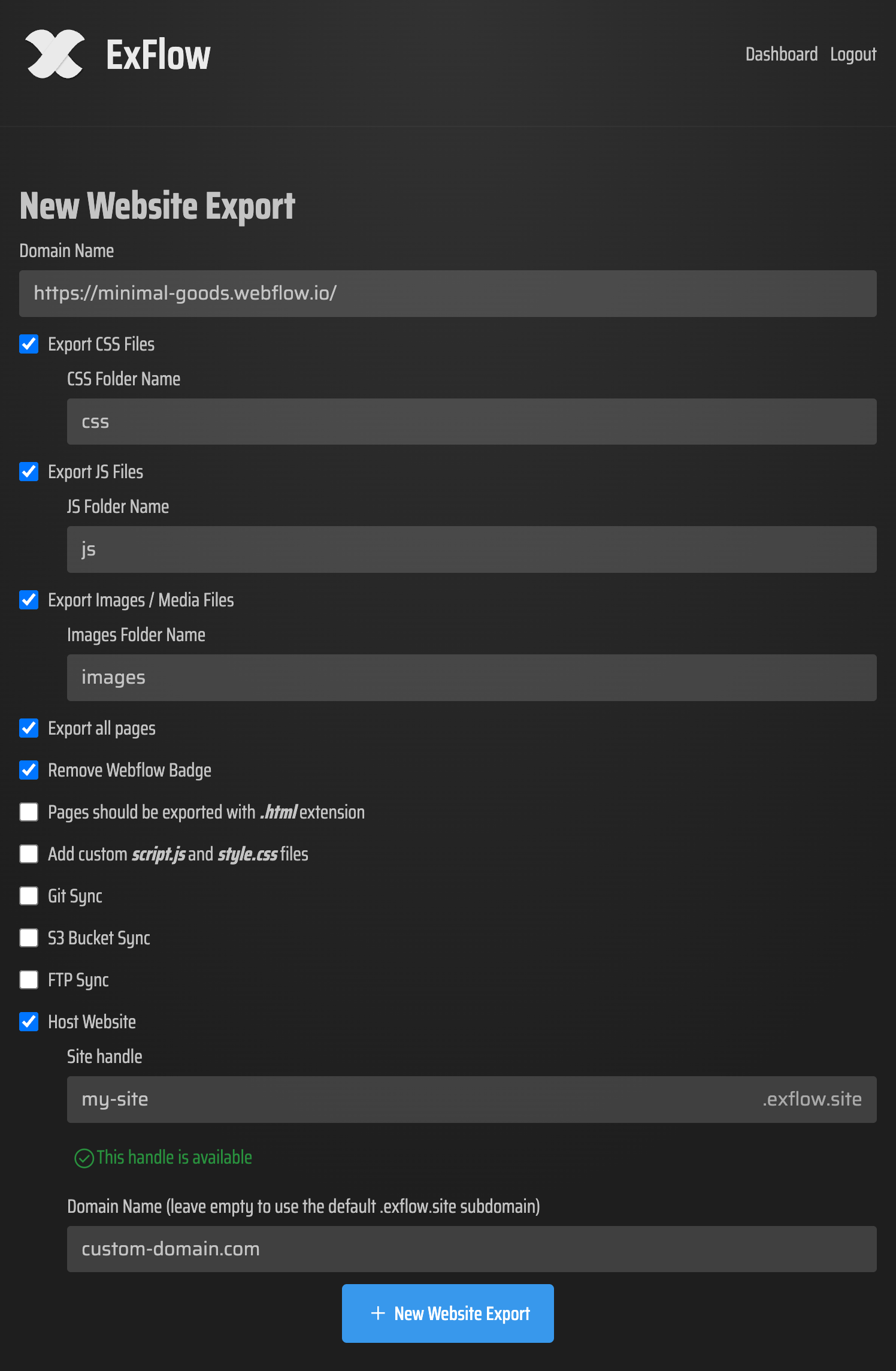
1) Paste your site URL into ExFlow’s Squarespace Downloader: https://exflow.site 2) Choose export options: Export CSS, Export JS, Export Images/Media, Export All Pages, Remove “Made with” badge, ensure .html pages, and optionally add custom script.js/style.css. 3) Download the ZIP—or sync directly to Git/S3/FTP or host on ExFlow’s servers with unlimited bandwidth and custom domain support (plan-dependent).
Read this before you export (safety and compliance)
- Get permission: Only export sites you own or manage; respect terms and third‑party licenses.
- Static vs dynamic: HTML exports won’t keep server-side features like native e‑commerce checkout, member areas, or built‑in search. Plan alternatives.
- Credentials hygiene: If you use sync options (Git/S3/FTP), create scoped credentials and rotate or revoke them after use.
- Password-protected sites: The owner can supply the password to ExFlow to unlock protected pages for export.
Step-by-step: Download a Squarespace site to HTML with ExFlow
1) Prepare your site
- Create a page inventory and note key templates, galleries, and index/section pages.
- List dynamic features (forms, search, store, comments) to replace later.
- Collect all domains/URLs you’ll need to redirect or preserve.
2) Configure your export in ExFlow
- Go to https://exflow.site and enter your Squarespace URL.
- Enable: Export CSS Files, Export JS Files, Export Images/Media Files, Export All Pages, and Pages with .html extension.
- Optional but recommended: Remove “Made with” badge; add custom script.js and style.css.
- Choose delivery: Download, or enable automatic Sync to Git, S3, or FTP. You can also select Hosting to deploy on ExFlow’s servers and link a custom domain. Many of these features vary by plan.
3) Handle access and protected pages
- If parts of your site are behind a password, provide it during export (owner-only). This ensures ExFlow can render and capture every page.
4) Export and retrieve
- Start the export and wait for processing. When complete, download the ZIP or confirm sync/hosting status.
5) Verify locally
- Unzip the bundle and run a quick local server (for example, Python’s
http.server). - Click through every page, gallery, and navigation item. Confirm fonts, animations, and media load correctly.
Make your static HTML bulletproof
Even the best Squarespace Exporter benefits from a quick hardening pass.
Links and navigation
Convert any stray absolute links (e.g., to the original domain) to your new domain.
Ensure the 404 page exists and your web host points to it.
Forms and search replacements
Forms: Replace with a static form handler (e.g., serverless endpoints or a form processing service). Update success/error messaging.
Search: Consider a lightweight client-side search (index.json + Lunr/Elasticlunr) if needed.
Performance and media
Use modern image formats (WebP/AVIF) where possible; keep fallbacks.
Add cache-control headers via your host or CDN.
Consider lazy-loading large galleries and videos.
SEO and analytics
Preserve title, meta description, canonical URLs, Open Graph, and Twitter cards.
Generate and upload sitemap.xml and robots.txt.
Reconnect analytics/ads pixels in your new static environment.
Accessibility and QA
Validate headings, alt text, color contrast, and focus states.
Test across modern browsers and mobile devices.
Deployment options (choose your path)
1) Host on ExFlow
- Easiest one-click path: Export and enable Hosting in ExFlow. You’ll get a fast static host with unlimited bandwidth and the option to link a custom domain. Check hosting status right in the dashboard.
2) Sync to Amazon S3 (static site hosting)
- Use ExFlow’s S3 Sync to push your export to a bucket.
- Enable static website hosting; set index.html and 404.html.
- Put CloudFront in front for global caching and HTTPS.
3) Sync to Git (GitHub/GitLab) and deploy
- Enable Git Sync in ExFlow to push your bundle.
- Deploy via GitHub Pages or Netlify/Vercel for speedy, CDN-backed hosting.
4) FTP to a traditional host
- Provide FTP credentials in ExFlow and let it upload the exported site.
- Confirm root path, index/404 behavior, and compression on the server.
Troubleshooting common issues
Missing pages in the export
Ensure “Export All Pages” is enabled. Re-run the export and verify protected sections were accessible.
Broken animations or interactions
Confirm Export JS Files was enabled. Some interaction libraries depend on exact file paths—keep ExFlow’s structure intact.
Images not loading or mixed content warnings
Update any http:// links to https:// and verify the correct relative paths.
CMS-driven content looks different
Because ExFlow captures fully rendered pages, styles should match. If something’s off, check for late-loading scripts or third-party embeds that require additional initialization.
Why use ExFlow vs. generic site downloaders?
- Purpose-built for modern no-code platforms: Generic tools like HTTrack struggle with dynamic content and interactions. ExFlow was designed to handle Webflow/Framer/Squarespace intricacies reliably.
- All-in-one workflow: Export, badge removal, .html pages, add custom assets, then sync to Git/S3/FTP or host directly—without juggling separate tools.
- Scales with your needs: Plans vary by number of sites, exports per month, max pages per export, export size, and syncing/hosting features.
For a quick look at the interface and export options:

Final checklist before going live
- [ ] All pages export to clean .html
- [ ] CSS/JS/Images present and minified where possible
- [ ] Forms and search replaced or disabled gracefully
- [ ] Canonicals, meta, OG/Twitter cards validated
- [ ] Sitemap.xml and robots.txt uploaded
- [ ] 404 page configured and tested
- [ ] HTTPS and redirect rules in place (www/non‑www, http→https)
Take control of your Squarespace site today
If you’re ready to Self-host a Squarespace site or looking for a practical Squarespace alternative for hosting, use ExFlow’s Squarespace Exporter and Squarespace Downloader workflow to get a clean Squarespace to HTML output in minutes—then deploy anywhere.
Start your export now: https://exflow.site

Comments
Post a Comment